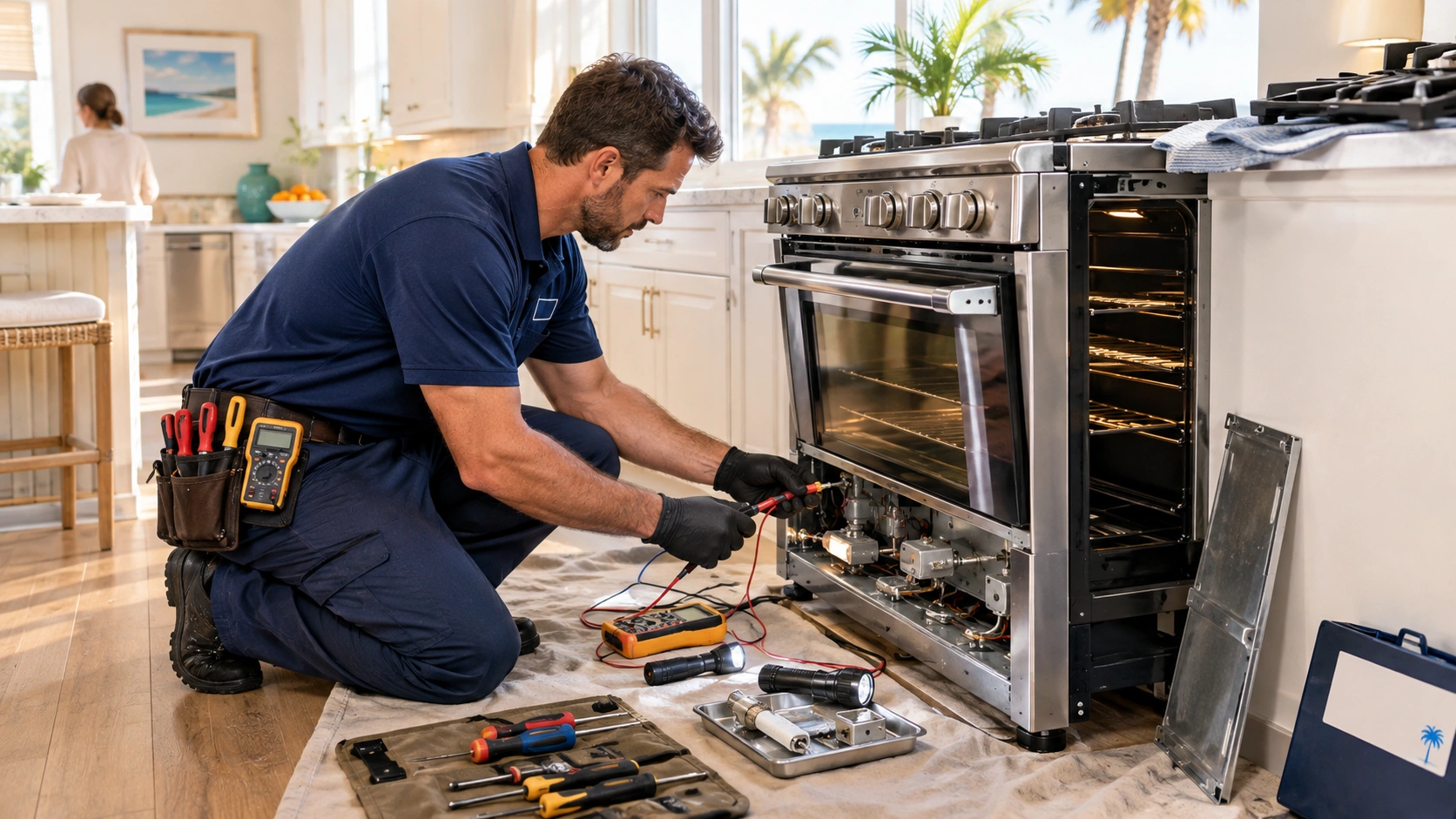
Every appliance company in this town will tell you "our humid climate is tough on appliances." That's true, but it's also vague enough to be meaningless. Here's what's actually happening inside your range.
Sarasota sits in a humid subtropical climate zone, and summer humidity regularly runs in the 70 to 80% range, with a wet season that stretches from roughly June through September. That moisture doesn't stay outside. It works its way into the same enclosed spaces where your range keeps its most sensitive components:
- Igniters and spark modules: Humidity buildup around the ignition assembly interferes with the spark path, which is why gas burners in coastal homes tend to click repeatedly instead of lighting on the first try.
- Control boards: The electronics behind your digital display and self-clean cycle are especially vulnerable to slow moisture intrusion over years, not just storms.
- Burner terminals and connection points: Homes closer to the water, particularly around Siesta Key, Lido Key, and the downtown bayfront (ZIP codes 34236 and 34242), see faster corrosion on metal contacts from salt-laden air.
Housing age matters too. A lot of the stock in Laurel Park, Gulf Gate, and pockets of downtown Sarasota (34237, 34234) dates to the 1970s through 1990s, so older wiring and older-generation ranges are still common there. Newer construction in Lakewood Ranch and Palmer Ranch (34240, 34238) tends to run higher-end ranges, Wolf, Viking, Thermador, Dacor, which need brand-specific diagnostic knowledge rather than a generic parts swap.
There's also a pattern unique to this market that almost nobody talks about: snowbird season. A large share of Sarasota's population is seasonal, and a range that sits completely unused for five or six months every summer comes back to life every fall with a much higher chance of igniter failure, a stuck self-clean latch, or a control board that won't wake up. If your range worked fine last spring and now won't start, sitting idle over the summer is very often the actual cause.